

Most associations think they know what they pay in credit card fees.
Ask the executive director and you’ll usually hear something like, “We’re around 2.5 to 3 percent all-in.” On the top line of the statement, that’s often true. The Visa rate is 1.61%. Mastercard is 1.74%. Amex is 1.60%. Add a small monthly fee and you arrive at a number that feels reasonable.
The problem is that the top line is not the bill.
Here is what the bill actually looks like for one nursing association we recently reviewed, using their own statements from their processor and gateway provider.
The Setup
The association runs a fairly standard payment stack: a legacy bank-owned processor handling card transactions, plus a third-party gateway sitting in front of it for tokenization and 3DS. They had used this combination for years. Their reporting was fragmented across two portals and reconciliation took staff time every month, but the costs felt manageable.
They processed roughly $248,000 in credit card volume across 824 transactions in 2024. Most of that came from membership renewals at $80 to $155 each, plus a national conference in August where registrations averaged $500 or more.
When we looked at their statements, the headline rates were exactly what you’d expect:
| Card type | Discount rate |
|---|---|
| Visa | 1.61% |
| Mastercard | 1.74% |
| American Express | 1.60% |
If you stopped reading there, you’d close the statement. Nothing looks wrong.
What’s Actually on the Statement
Below the discount rates, the statement lists a stack of percentage-based fees applied to the same volume. Every one of these is a real line item on the actual statement, charged on every transaction, every month:
| Fee | Rate |
|---|---|
| Data security fee | 0.89% + $0.32/txn |
| System maintenance fee | 0.90% + $0.30/txn |
| Network access fee | 1.18% + $0.25/txn |
| Risk assessment fee | 0.95% + $0.27/txn |
| PCI admin | 0.43% + $0.09/txn |
| PCI non-compliance | 0.13% + $0.04/txn |
Add it up: about 4.5% in additional percentage-based fees, plus $1.27 per transaction, before you get to interchange downgrade fees, authorization fees, statement fees, gateway fees, or the fixed monthly miscellaneous charges that show up at the bottom of every bill.
Interchange downgrades alone added another 1.5–2% on most card-not-present transactions. The fixed monthly charges (network access, system maintenance, risk assessment, PCI admin, statement fees, portal services) added roughly $180 every month regardless of volume.
The Actual Effective Rate
Across four consecutive monthly statements we reviewed, the blended effective rate landed between 9.85% and 16.70%.
| Month | Volume | Total fees | Effective rate |
|---|---|---|---|
| December | $2,559 | $427 | 16.70% |
| January | $5,768 | $764 | 13.24% |
| February | $8,502 | $838 | 9.85% |
| March | $6,819 | $1,004 | 14.72% |
The lower-volume months looked worse because the fixed monthly charges hit a smaller base. Annualized across the full year, including the high-volume conference month where larger tickets diluted the per-transaction fees, the blended rate works out to roughly 10%.
To translate that into dollars: on $248,000 of card volume, this association paid about $24,800 in combined processor and gateway fees in 2024.
If they had used the rate they thought they were paying, they would have expected closer to $7,500.
That’s a gap of roughly $17,000 a year, sitting in line items nobody had time to audit.
Why This Happens
It isn’t a “bad processor” story. The processor is a major Canadian bank-owned acquirer used by tens of thousands of merchants. The base interchange rates are exactly what they should be. The gateway provider is a legitimate Canadian company with a real product.
The cost lives in everything layered on top:
- Percentage-based “operational” fees that look like flat administrative charges but compound on volume
- Per-transaction add-ons that hit hardest on low-ticket payments like membership dues
- Interchange downgrade fees on card-not-present transactions, which is most of what an association processes
- Fixed monthly charges that get worse as a percentage of small months
- Gateway fees stacked on top of processor fees, often duplicating risk and security charges already billed by the processor
None of this is hidden. It’s all on the statement. It’s just on page four, in a table that needs a glossary to read.
What X-CD Payments Costs on the Same Volume
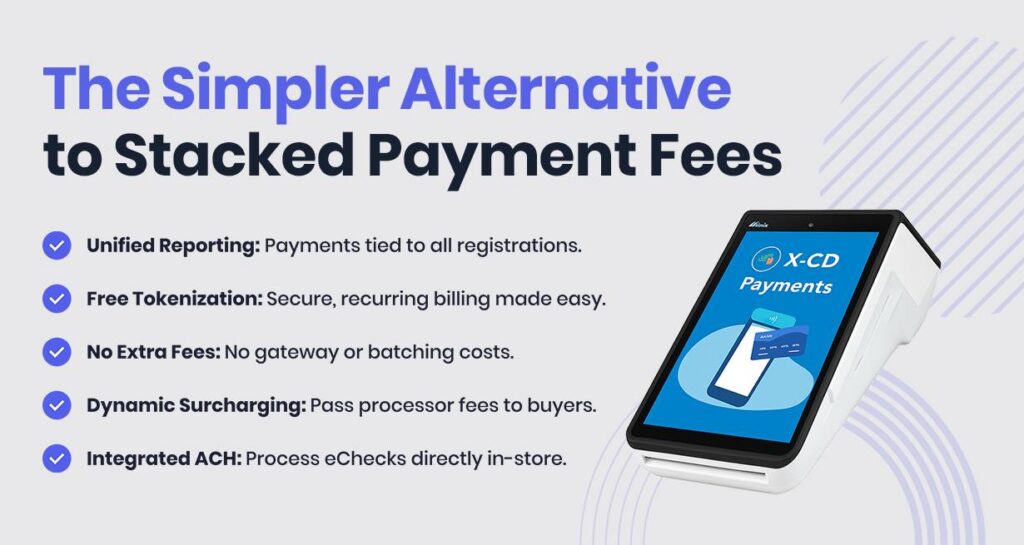
We built X-CD Payments to consolidate payments inside the X-CD ecosystem so associations don’t have to stitch together a processor, a gateway, and a registration system that all report differently. Cost reduction wasn’t the original goal. It turns out to be a side effect.
On the same $248,000 in volume and 824 transactions, X-CD Payments would have cost:
- 2.9% interchange-plus: $7,191
- $0.30 per transaction: $247
- 2% platform fee: $4,960
- Total: $12,398, or roughly 5.0% effective
Compared to the $24,800 the association actually paid in 2024, that’s about $12,500 in annual savings, or a 50% reduction in payment costs.
For associations that choose to pass a portion of the credit card fee to members paying by card (a common practice), the net cost to the association drops further. Members paying by EFT or bank transfer continue to flow through at lower cost.
The Operational Side
The financial savings are the easy part to quantify. The operational change is harder to put a number on but usually matters more day to day:
- One reconciliation report instead of three
- Deposits that match registration records without manual matching
- Tokenized card-on-file for auto-renewing memberships, included rather than billed as an add-on
- Onsite event terminals reporting into the same system as online registrations
- One support contact when something goes wrong
For a finance team that currently spends part of every month chasing why the gateway report doesn’t match the processor deposit, that’s the change they notice first.
What to Do with This
If you run payments for an association and you haven’t gone through your statement line by line in the last twelve months, do that first. Two questions to ask:
- What is my actual effective rate? Take the total fees on the bottom of the statement, divide by gross volume, and compare to the discount rate at the top.
- How many separate vendors am I paying to move one payment? Processor, gateway, tokenization, PCI services, and registration platform are often four or five separate bills.
If the gap between your stated rate and your effective rate is larger than you expected, you’re not alone. It’s the default outcome of how merchant services pricing is structured. The point isn’t that any single fee is illegitimate. It’s that the cumulative effect is invisible unless you go looking for it.
Your stated rate is not your effective rate. If you haven’t checked recently, there’s a reasonable chance you’re paying two to four times what you think.