
Event management platforms collect registration data, payment details, dietary preferences, and sometimes government-issued ID numbers from attendees. Because this data is governed by privacy regulations like GDPR, organizations that use these platforms are accountable for how it is stored, processed, and shared.
This article explains what security features to look for, which compliance frameworks apply, and how to evaluate vendor data practices before signing a contract.
TLDR: Event Management Data Security and Privacy
- Event management software collects personal data such as registration details, contact information, payment data, and attendee engagement activity. This information may be subject to privacy laws such as GDPR, CCPA/CPRA, and other regional data protection regulations. If your platform processes payment card data, it must also meet PCI DSS security standards.
- In most event scenarios, the event organizer acts as the data controller, while the event management software provider acts as a data processor handling information on your behalf. However, the exact roles depend on how the vendor uses the data. As the controller, your organization typically carries primary responsibility for obtaining consent, defining how attendee data is used, and ensuring compliance with applicable privacy laws.
- When evaluating vendors, confirm that the platform follows established security practices. Look for protections such as encryption in transit and at rest, strong access controls, secure backup and disaster recovery procedures, and documented incident response processes. Independent security certifications such as SOC 2 Type II, ISO 27001, or comparable audits can help validate these controls.
- If your event collects or processes data from EU residents, GDPR requires a written agreement governing how the processor handles personal data on behalf of the controller. This is commonly provided as a Data Processing Agreement (DPA) or incorporated into the vendor contract and should outline responsibilities, safeguards, and breach notification procedures.
- Incident response policies are another key area to review. Vendors should commit to prompt breach notification without undue delay, enabling your organization to meet regulatory reporting timelines (such as the 72-hour reporting window required of controllers under GDPR).
- Remember that security responsibilities extend beyond the software platform. When attendee lists or reports are downloaded to local computers, exported to spreadsheets, saved on USB drives, or printed, those copies fall outside the vendor’s security controls. Your organization is responsible for protecting that data through internal policies and access controls.
- Before signing with any event management software provider, ask for documentation covering their security certifications, data processing terms, backup and disaster recovery practices, breach notification policies, and risk management measures such as cyber liability coverage. These materials help ensure the platform meets your organization’s security and compliance expectations.
What Data Does Event Management Software Collect?
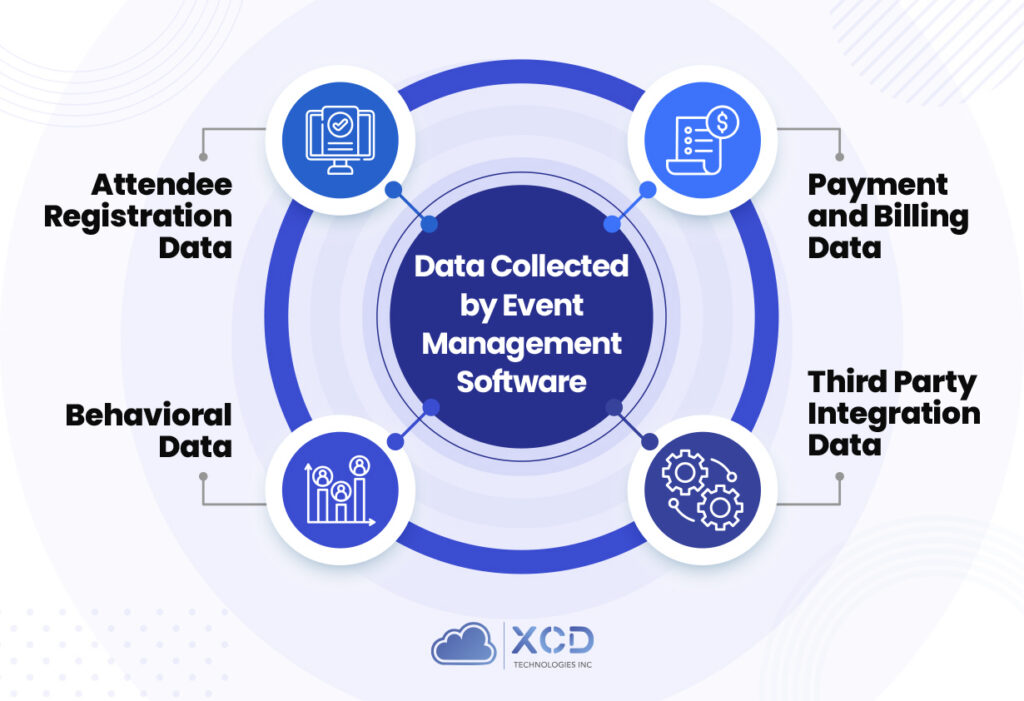
Event management platforms collect a wide range of personal data across multiple categories, including:
- Attendee registration data
- Payment and billing data
- Behavioral data
- Third-party integration data
Understanding what is collected, how it is used, and which data types create the highest regulatory risk is the first step in evaluating a vendor’s security posture.
Attendee Registration Data
Attendee registration data often includes names, email addresses, job titles, phone numbers, and other personal details. Under GDPR, collecting this data requires a valid legal basis. That basis is not always consent. In many cases, the data can be processed because it is necessary to register the attendee, fulfill legal obligations, or support legitimate event operations.
Payment and Billing Data
Payment and billing data may be collected directly or through an integrated payment provider. Any organization or service provider that stores, processes, or transmits cardholder data, or can impact the security of the cardholder data environment, falls within PCI DSS scope.
Behavioral Data
Behavioral data can include session attendance, in-app activity, engagement scores, and content interaction logs. When this information can be linked to an identified or identifiable person, it is personal data under GDPR.
Third-Party Integration Data
Third-party integration data flows when an event platform syncs with CRM systems, marketing automation tools, analytics tools, or payment providers. Each integration creates another transfer point that should be covered by clear contractual terms, access controls, and documented processor or subprocessor relationships where applicable.
Data To Be Extra Cautious About
Some event workflows may involve higher-risk data, such as health information for accommodations, government-issued identification numbers for credentialing, or biometric data used to verify identity. Under GDPR, health data and biometric data used to uniquely identify a person can fall within special categories of personal data under Article 9. Government-issued identification numbers are addressed separately under Article 87, not as special-category data, but they still require appropriate safeguards and may be subject to additional national rules. These data types should only be collected when there is a clear legal basis, a defined business need, and appropriate safeguards in place.
What Privacy Regulations Apply to Event Management Software?
Multiple regulations can apply to event data, depending on attendee location, the nature of the data collected, the role of each party, and whether the organization meets the law’s scope thresholds, including GDPR, CCPA, PIPEDA, and PCI DSS.
GDPR (EU)
The General Data Protection Regulation can apply when an organization offers services to people in the EU or processes their personal data in a way that falls within the regulation’s territorial scope. In many event software deployments, the event organizer acts as the controller and the software vendor acts as the processor, although roles can vary depending on how the service is configured and what the vendor does with the data. GDPR requires a lawful basis for processing, supports rights such as access and erasure, and requires processor relationships to be governed by contract.
CCPA, as amended by CPRA (California)
California’s privacy law gives California residents rights that can include knowing what personal information is collected, requesting deletion, correcting certain information, and opting out of the sale or sharing of personal information. It applies to qualifying businesses that meet the law’s thresholds, not automatically to every event organizer or software vendor.
PIPEDA (Canada)
PIPEDA is Canada’s federal private-sector privacy law for personal information handled in the course of commercial activity. It does not automatically apply simply because a Canadian attends an event. Its application depends on the organization, the activity, and whether provincial private-sector laws also apply.
PCI DSS
PCI DSS applies to entities that store, process, or transmit cardholder data and to those that can affect the security of that environment. Event organizers should verify how payments are handled, whether the event platform itself is in scope, and what responsibilities sit with the payment processor.
What Security Features Should Event Management Software Have?
When evaluating an event management platform, the following security capabilities are the minimum standard for any system that handles personal data. Each feature reduces a specific category of risk. X-CD is an example of event management software with all of these security features.
- Network perimeter security: A production platform should operate behind a firewall and Intrusion Prevention System (IPS) capable of stateful and deep packet inspection. DDoS protection mechanisms should be active at the perimeter to prevent service disruption during high-traffic events.
- Server high availability: Virtualized server environments with automated failover ensure that a hardware failure does not result in extended downtime. Organizations running mission-critical events should confirm the vendor’s recovery time objective in the event of a physical server failure.
- Geographic failover: A secondary failover server in a separate geographic location protects against regional disruptions. Confirm whether the vendor’s primary and backup infrastructure are in distinct locations.
- Redundant storage: Enterprise SAN (Storage Area Network) arrays configured with RAID, redundant controllers, and cross-replication protect against storage failure. Ask whether the vendor’s storage is replicated to a second array.
- Frequent, off-site backups: Database backups should be performed multiple times daily and stored off-site in a geographically separate location. Frequency matters: a backup taken once at night can mean a full day of lost data if a failure occurs the following afternoon.
- Anti-virus and anti-spam controls: All inbound and outbound email should be filtered, and servers should run active anti-virus software. Multi-tenant platforms carry additional risk: compromised form submissions from one client’s site can affect others on the same server.
- Physical datacenter security: The facilities housing the vendor’s servers should have 24×7 on-site security, access control systems, and fire suppression. Biometric access controls are a higher standard than access codes alone.
- Consent and preference management: A compliant platform should support clear privacy notices and, where consent is the chosen lawful basis or marketing communications require opt-in, should make it possible to obtain, record, and manage that consent. Consent records should be specific, time-stamped where appropriate, and easy for users to review or update. Consent is not required for every processing activity, so the platform should support workflows that align with the organizer’s actual lawful basis.
- Self-service data deletion: Clients should be able to delete attendee records without vendor intervention, satisfying the GDPR right to erasure.
- Breach notification commitment: The vendor contract should require the vendor to notify the client without undue delay after becoming aware of a personal data breach. Under GDPR, the controller is generally responsible for notifying the supervisory authority and, where feasible, must do so within 72 hours of becoming aware of a reportable breach. A shorter contractual notification commitment from the vendor is typically helpful, not non-compliant.
- Cyber insurance: Ask whether the vendor maintains cyber liability insurance. This does not replace security controls but signals that the vendor has formally assessed their breach risk and has a financial backstop in place.
How to Evaluate a Vendor’s Data Security Before You Buy
Use the following framework when assessing the data security of event management software vendors. These questions can be submitted directly to a vendor during procurement.
- Request the vendor’s most recent SOC 2 report or equivalent independent security audit. Ask whether it is a Type 1 (point-in-time design review) or Type 2 (operational effectiveness over time) report.
- Ask where attendee data is stored and whether the vendor operates a geographic failover server. Confirm that primary and backup infrastructure are located in separate regions.
- Confirm whether the vendor will sign a GDPR Data Processing Agreement. Request their standard DPA and have legal counsel review it before signing any contract.
- Ask how expressed consent is captured and recorded. Confirm whether the platform time-stamps consent, allows users to update their preferences, and supports configurable email consent categories.
- Ask which third parties receive attendee data and under what conditions. Request a list of sub-processors and confirm whether the vendor maintains data processing agreements with each.
- Confirm data deletion capabilities. Ask whether your organization can delete attendee records independently — without vendor intervention — and whether deletion can be triggered on demand.
- Ask how frequently database backups are performed and where backups are stored. Daily off-site backups are a baseline requirement; higher backup frequency reduces potential data loss.
- Confirm the vendor’s breach notification commitment. GDPR requires notification to supervisory authorities within 72 hours of a vendor becoming aware of a breach — verify this is reflected in the vendor’s contract.
- Ask whether the vendor carries cyber liability insurance. Request details on coverage scope so you understand what financial protection exists in the event of a breach originating within the vendor’s infrastructure.
Frequently Asked Questions
Is event management software GDPR compliant?
Event management software can be GDPR compliant, but compliance depends on both the vendor’s data practices and how the organization configures the platform. The vendor operates as a data processor under GDPR and the event organizer is the data controller, meaning the organizer bears the primary legal obligation to establish a lawful basis for data collection, obtain appropriate consent, and enter into a signed Data Processing Agreement with the vendor.
Buyers should verify that their vendor offers a formal DPA, provides tools for attendees to update or withdraw consent, and supports the right to erasure.
Can event management software be hacked?
Any software platform is a potential target for unauthorized access. Common attack vectors include credential attacks on admin accounts, vulnerabilities in third-party integrations, and data breaches originating from client-side computers or local storage where attendee data has been downloaded. Vendor-side controls, including firewalls, intrusion prevention systems, DDoS protection, anti-virus software, and physical datacenter security, reduce the risk of server-level breaches. Client-side handling of attendee data is a separate responsibility that the event organizer must address independently.
How X-CD Approaches Data Security and Privacy
X-CD is designed for academic associations and professional conference organizers operating in regulated environments and serving international audiences. The platform acts as a data processor under GDPR, with clients retaining the role of data controller and full responsibility for the data they choose to collect.
Infrastructure and Availability
X-CD hosts client data on Dell servers with Dell Compellent enterprise SAN storage arrays. Servers are virtualized using VMware vSphere with High Availability enabled: if a physical server fails, affected virtual machines are automatically migrated to a functioning server and resumed, typically within 3 to 5 minutes. Storage is configured in high-performance RAID arrays with redundant controllers, redundant network adapters, and daily cross-replication to a second SAN array. Power is supplied from two separate feeds backed by UPS systems and diesel generators, with servers and storage devices running on redundant power supplies.
X-CD operates a geographic failover configuration: the primary server is located in St. Louis, Missouri, with a secondary failover server in Ashburn, North Carolina.
Should the primary server fail, client data and operations can be recovered from the secondary location.
Network Security
X-CD’s infrastructure is protected by a perimeter firewall and Intrusion Prevention System (IPS) configured with stateful packet inspection, deep packet inspection for known malicious attack patterns, and DDoS protection mechanisms. All inbound email is filtered using real-time RBL and content inspection technologies. Outbound mail from web servers is checked with anti-spam filters to prevent one client’s compromised submission forms from affecting email delivery for others on the same server. Servers run AVG CloudCare Anti-Virus.
Backups
X-CD performs daily backups of all web, email, and database servers. Database backups are performed six times per day. All backups are stored off-site in a geographically separate location from the primary servers, ensuring that a regional disaster affecting the primary datacenter does not compromise backup data.
Physical Security
The datacenters housing X-CD’s servers maintain 24×7 on-site security and multi-layer access control, including access codes, biometric hand scanners, electronic proximity readers, and a security surveillance system. Equipment is protected by a pre-action, dry pipe fire suppression system.
GDPR Compliance and Consent
X-CD’s GDPR compliance framework requires all contacts to provide expressed, time-stamped consent before submitting any personal information. The platform’s email management module supports configurable consent categories, a default Do Not Contact setting, and user-facing controls that allow attendees to view and update their consent status at any time. Clients can use X-CD’s backend tools to delete attendee records immediately and independently, without contacting X-CD, satisfying the GDPR right to erasure.
Breach Notification and Insurance
X-CD commits in each client agreement to notify clients within 72 hours of becoming aware of a data breach. X-CD also maintains cyber liability and business interruption insurance to cover claims arising from a breach originating within its own servers or caused by an X-CD employee action, up to a defined aggregate limit. Coverage does not extend to breaches originating from client servers, client employee computers, or other external sources — reflecting the shared responsibility model that applies to all cloud-hosted platforms.
SOC 2 Certification
X-CD holds a SOC 2 Type 1 certification, confirming that its security controls were independently audited and found to be appropriately designed.