

Your call for abstracts sets the tone for your entire conference. It’s the first formal interaction many researchers have with your event, and it directly influences the caliber of research that ends up in your program.
Yet too often, organizers treat the call for abstracts as a checkbox exercise: post the announcement, open submissions, and hope for the best. The result is a flood of submissions that miss the mark, incomplete applications that slow down review, and a program that doesn’t reflect your conference’s true potential.
The good news is that small, strategic changes to how you craft and communicate your call for abstracts can dramatically improve both submission quality and volume. From clearer guidelines and smarter formatting requirements to better timing and targeted outreach, the practices that separate a mediocre response from an exceptional one are well within your control.
This article breaks down proven strategies for strengthening your call for abstracts, enabling you to attract research that elevates your conference and engages your community.
What Is A Call for Abstracts In Conference Planning?
A call for abstracts is a formal invitation for researchers, academics, and practitioners to submit summaries of their work for consideration in your conference program. It outlines what you’re looking for, how submissions should be formatted, and the deadlines submitters need to meet.
For conference organizers, the call for abstracts is much more than an administrative announcement. It’s a strategic tool that shapes your scientific program from the ground up.
Unlike invited sessions or keynote speakers you select directly, the abstract submission process opens your conference to the broader research community. It surfaces emerging work, attracts new voices, and gives your attendees access to findings they won’t encounter anywhere else. The submissions you receive, and ultimately accept, determine the depth, diversity, and relevance of your program content.
A well-executed call for abstracts also reinforces your conference’s reputation within the field. When researchers see clear expectations, a fair review process, and a professionally managed submission experience, they’re more likely to submit their strongest work and to return year after year.
In short, your call for abstracts is how you signal to your community what your conference stands for and the quality of scholarship you expect.
Best Practices to Improve Abstract Submission Quality
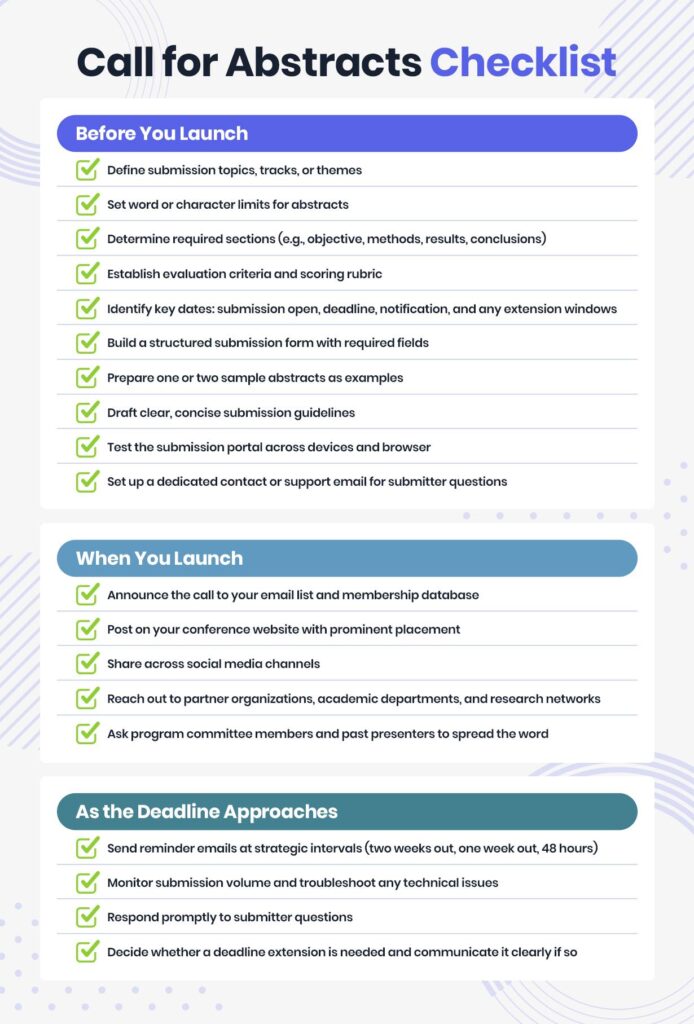
Improving submission quality requires more than author intent. Clear expectations, defined structure, and consistent oversight help ensure submissions are complete, relevant, and evaluated fairly from intake through final decision.
Define Clear Submission Guidelines and Evaluation Criteria
Ambiguity is the enemy of quality. When researchers don’t understand exactly what you’re looking for, they’re more likely to submit work that misses the mark or skip submitting altogether.
Your call for abstracts should spell out the basics:
- Word or character limits
- Required sections (objective, methods, results, conclusions)
- Formatting rules
- Any topic tracks or themes.
But don’t stop there. Share the criteria your reviewers will use to evaluate submissions. When submitters know they’ll be scored on originality, methodological rigor, and relevance to the conference theme, they’ll tailor their abstracts accordingly.
Transparency up front means fewer misaligned submissions later, and a stronger program overall.
Use a Structured Submission Form
A blank text box invites inconsistency. A structured submission form guides submitters toward completeness.
Build your form with dedicated fields for each required element:
- Title
- Author information
- Abstract body
- Keywords
- Topic track
- Presentation format preference
This ensures you collect the information you need in a standardized way, which makes life easier for both submitters and reviewers.
Structured forms also reduce common errors. Required fields prevent incomplete submissions, character limits keep abstracts focused, and dropdown menus eliminate guesswork on categorization. The result is a cleaner dataset and a smoother review process.
Provide Examples of Strong Abstracts
Telling submitters what you want is helpful. Showing them is even better.
Include one or two sample abstracts in your call for submissions, ideally past submissions that were well-received. Annotate them if possible, pointing out what made them effective.
Examples demystify expectations and give first-time submitters a concrete model to follow. They’re especially valuable for early-career researchers who may be less familiar with your conference’s standards.
Set Strategic Deadlines
Your timeline matters more than you might think. Deadlines that are too tight can discourage busy researchers from participating. Deadlines that drag on too long can lead to last-minute rushes and lower-quality submissions.
Allow sufficient lead time for submitters to prepare thoughtful abstracts, typically six to eight weeks from the announcement to the deadline.
It’s also a good idea to consider your field’s rhythms: avoid major competing conferences, grant deadlines, or academic calendar crunches when possible.
If you plan to offer a deadline extension, be strategic about it. A short, clearly communicated extension can boost volume without undermining urgency. Just be sure your review timeline can absorb the shift.
Make the Submission Process User-Friendly
If your process is confusing, slow, or prone to technical glitches, you’ll lose people before they click “submit.”
Ensure your submission portal functions seamlessly across devices and browsers, and provide clear instructions at each step. Additionally, it’s important to allow users to save drafts and return later.
Responsive support matters too. Offer a dedicated contact for submission questions and respond promptly.
A smooth, professional experience reflects well on your conference and encourages researchers to engage with you again.
Use Integrated Software to Support the Full Conference Lifecycle
Abstract management doesn’t exist in a vacuum. The submissions you collect connect to speaker coordination, program scheduling, registration, continuing education credits, and more.
When your abstract management system operates in isolation, you create extra work—and extra room for error. Staff end up manually transferring data, reconciling spreadsheets, and fielding preventable questions from presenters who received conflicting information.
Integrated conference management software eliminates these gaps. Accepted abstracts flow directly into your speaker management and program tools. Author details sync with registration. Presentation assignments connect to your mobile app and digital signage. The result is a cohesive experience for your team, your reviewers, and your presenters—from the first submission to the final session.
The Benefits of a Well-Structured Call for Abstracts
When you invest time in crafting a clear, strategic call for abstracts, the returns extend far beyond your submission inbox. A well-structured process strengthens your program, streamlines your operations, and builds lasting trust with your research community.
- Higher-quality submissions. Clear guidelines and structured forms help submitters put their best work forward, reducing the number of incomplete or off-topic abstracts your reviewers have to sift through.
- A more efficient review process. Standardized submissions are easier to evaluate consistently, which speeds up decision-making and reduces back-and-forth with submitters.
- A stronger, more relevant program. When researchers understand your expectations and evaluation criteria, the work they submit aligns more closely with your conference themes and audience interests.
- Increased submission volume. A user-friendly process with clear deadlines and targeted outreach removes barriers to participation, attracting both seasoned presenters and first-time submitters.
- Reduced administrative burden. Fewer errors, fewer incomplete applications, and fewer frantic emails from confused submitters mean your team can focus on higher-value work.
- Enhanced reputation in your field. A professional, transparent submission experience signals that your conference is well-run, making researchers more likely to submit, attend, and recommend your event to colleagues.
- Better data for future planning. Structured submissions give you consistent, usable information to analyze trends, track participation, and refine your approach year over year.
How X-CD Supports a Scalable, High-Quality Call for Abstracts
Getting your call for abstracts right takes the right infrastructure. X-CD’s abstract management module is purpose-built for academic and scientific conferences, giving you the tools to implement every best practice covered in this article without the administrative headaches.
With X-CD, you can create fully customizable submission forms that capture exactly what you need, complete with required fields, character limits, and topic track categorization. A clean, intuitive interface also makes submitting simple.
But where X-CD truly stands apart is integration. Your abstract management module connects seamlessly with speaker management, event registration, mobile apps, continuing education tracking, digital posters, proceedings archives, and more—all on one platform. Accepted abstracts flow directly into your program, presenter details sync automatically, and session assignments appear in your event app without manual re-entry.
For your team, this means less time wrestling with disconnected systems and more time focused on delivering an exceptional conference experience. For your presenters, it means a professional, cohesive journey from submission to presentation.
Whether you’re managing a few hundred abstracts or several thousand, X-CD scales with you, year after year.
Ready to see how X-CD can elevate your call for abstracts? Request a demo and discover how our all-in-one platform helps academic and scientific conferences attract better research and run more smoothly.