

In 2025, the meaning of a “successful” event looks very different from what it did a few years ago. Consider the United States and Canadian Academy of Pathology (USCAP) Annual Meeting, which attracts over 4,000 global attendees each year.
Its success isn’t measured by how many people fill the room, but by how effectively it connects thousands of medical professionals through meaningful education and engagement.
What’s changed is how organizers achieve that success. Today’s conferences must deliver the same high-quality learning and networking experiences across in-person, virtual, and hybrid environments, all while tracking measurable outcomes that prove impact.
Event planners everywhere face similar expectations. Attendees now seek seamless, personalized experiences that help them connect and grow professionally, while organizations demand clear metrics that demonstrate value and impact.
Understanding the five characteristics of event success means recognizing that impact is built on strategy, insight, and connection.
5 Characteristics of Event Success
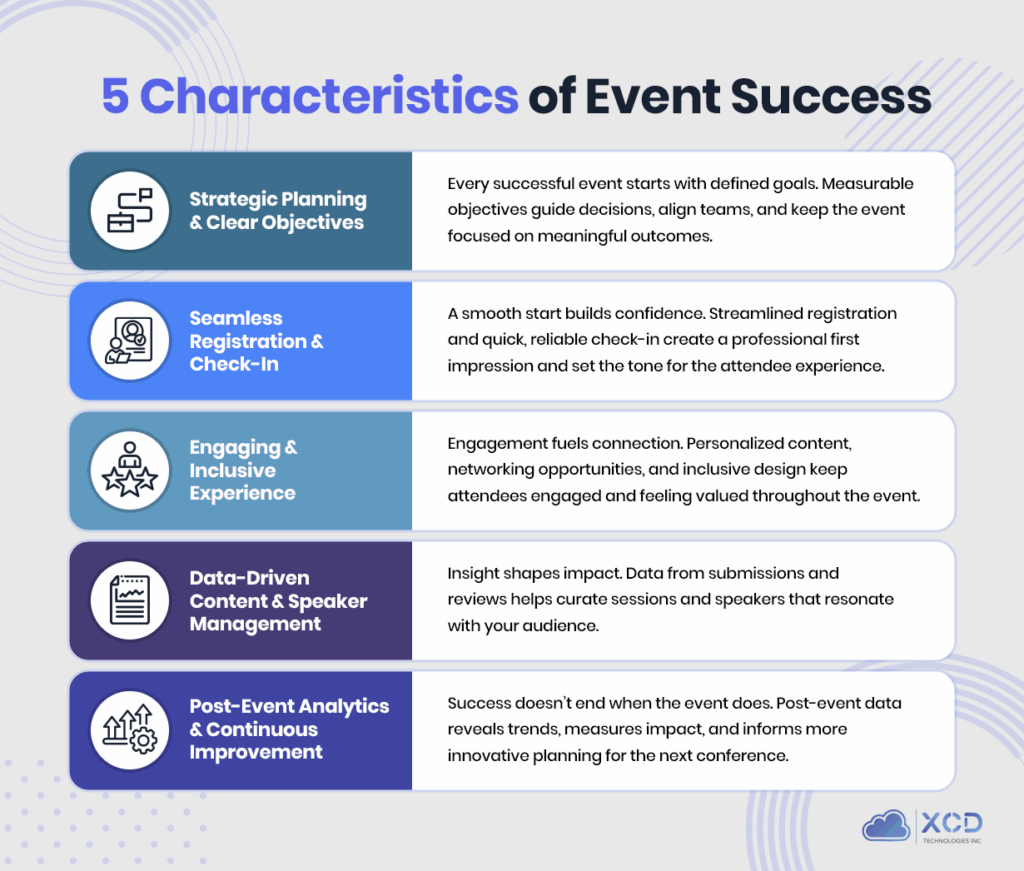
Successful event planning begins with strategy, an intentional process that defines why the event exists, who it serves, and what success should look like.
1. Strategic Planning and Clear Objectives
Strategic planning involves setting priorities early, aligning your event with organizational goals, communicating effectively with partners, and identifying the necessary resources to make your goals achievable.
Clear objectives help transform ideas into measurable outcomes that align with the priorities of your target audience. They should focus on a few key factors that help shape success, including attendance growth, engagement quality, sponsorship value, and post-event retention.
For instance, an association might set a goal to maximize attendance by tailoring outreach to specific member segments or improve engagement by reshaping session formats based on attendee feedback.
When event goals are specific, measurable, and time-bound, planning becomes focused and data-driven. Every decision, from marketing campaigns to speaker selection, is made with a defined purpose in mind.
Clarity helps teams stay aligned, ensures accountability, and creates memorable experiences that deliver lasting value.
2. Seamless Registration & Event Check-In
Registration is often the first signal of an event’s success. A simple, intuitive process builds confidence in attendees and sets the tone for everything that follows. Modern event registration systems, like X-CD’s, bring together member data, pricing rules, and registration paths in one centralized platform, making the process faster for attendees and more efficient for teams.
At the same time, seamless and efficient onsite check-in is critical for ensuring attendee satisfaction. Modern technology, such as self-service kiosks with QR code scanning and real-time badge printing, enables attendees to move through the check-in process quickly, eliminating the need to wait in long lines.
Additionally, QR-enabled badges can be used throughout the conference for access control, exhibitor lead retrieval, and session attendance tracking, creating a connected experience from start to finish.
For academic and medical conferences, this integration is especially valuable. Organizers can track attendance at specific sessions to verify participation for continuing education credits while maintaining an accurate record of overall event attendance.
When registration, check-in, and attendance tracking operate within one integrated system, staff avoid duplication, attendees move through the process smoothly, and sponsors and exhibitors gain better visibility into engagement.
3. Engaging and Inclusive Attendee Experience
Engagement is a measurable factor in how attendees value and remember a conference.
An engaging attendee experience begins with personalized communication, continues through meaningful interactions during the event, and extends through post-event touchpoints that keep people connected.
Inclusivity also plays a pivotal role. When attendees feel that the program values diverse perspectives, accommodates various access modes, and offers multiple learning paths, participation improves, and retention increases.
Hybrid conference tools (including AI-powered matchmaking and attendee portals) help expand access and strengthen connections and satisfaction.
4. Data-Driven Content and Speaker Management
One of the essential characteristics of a successful conference is content that reflects the audience’s interests and the organization’s purpose. Achieving that balance requires meticulous attention to session data and feedback collected throughout the event cycle.
For example, a scientific association might analyze session trends from previous conferences to identify which research topics attracted the highest attendance and engagement.
Pairing those insights with peer review scores allows planners to design a program that highlights emerging areas of research while still covering foundational subjects.
The peer review process plays a critical role in maintaining academic integrity and quality. With X-CD’s peer review software, associations can manage evaluations, scoring, and reviewer assignments in one place, ensuring that only the most relevant, high-caliber content is included on the conference agenda.
Innovative approaches, such as using AI-assisted tools to group abstracts by theme or track speaker engagement across sessions, help planners refine their lineup with precision.
An integrated abstract and speaker management system consolidates submissions, reviews, and scheduling into a single, connected workflow.
The result is a streamlined process that reduces administrative work, supports reviewers, and strengthens overall program quality.
5. Post-Event Analytics and Continuous Improvement
The lifecycle of an event doesn’t end when the final session concludes. What happens afterward can determine whether your event reaches its full potential or not.
Post-event analytics transform feedback and performance data into actionable insights that can guide smarter planning for future conferences.
Successful organizers begin this process with clear goals. Comparing these objectives against actual outcomes helps teams identify achievements and challenges. For instance, analyzing session attendance might reveal that workshops on emerging technologies attracted more participants than traditional lecture formats, signaling a shift in audience preference.
Meticulous detail ensures this analysis goes beyond surface-level metrics. Evaluating survey comments, session ratings, and engagement heatmaps provides context behind the numbers.
These insights highlight learning opportunities and help planners refine marketing, content, and logistics for next year’s event.
Each data point contributes to a continuous improvement cycle that helps conferences evolve and improve. Over time, these insights make events better organized and more aligned with the needs of their community.
Additional Elements That Elevate Conference Success
Beyond the key characteristics of event success, a few intentional choices can separate good events from great ones. Small details can reflect an organization’s values and its long-term commitment to its community.
Design Events That Everyone Can Access and Enjoy
Accessibility and equity are key for modern conferences. This means offering accessible registration, hybrid delivery (in-person + virtual), closed captioning, translation services, and thoughtful design that doesn’t leave any attendee behind.
Designing events for everyone helps increase participation and encourages attendees to return. An inclusive approach can help strengthen your event’s reputation over time.
Make Sustainability Part of the Event Experience
Environmental responsibility has become a central aspect of how attendees perceive events.
Sustainable badges, online programs, and on-demand content reduce waste and costs while reinforcing modern values and a thoughtful brand reputation.
Each step towards sustainability signals awareness and modern values that can help strengthen your event’s reputation.
Build Stronger Relationships Through Smarter Sponsorships
Sponsorships are most effective when they create genuine value for both parties. Matching sponsors with the right audience makes their presence feel relevant and adds genuine value to the attendee experience.
Data helps planners demonstrate clear results and build lasting relationships that extend beyond a single event. Over time, that focus evolves into trusted partnerships that support the broader goals of the conference.
How to Elevate Event Execution for Lasting Success
Even the strongest event plan can fail without solid execution. Teams need clear workflows and connected data to stay organized and efficient.
As those pieces come together, events run smoothly and deliver a consistent experience from planning to wrap-up.
Break Down Silos with a Centralized Event Ecosystem
Separating registration, content, analytics, and on-site logistics across different systems results in inefficiencies and poor communication. A centralized ecosystem keeps everything connected, allowing data to flow freely between teams and tasks, ensuring alignment.
Before building or upgrading your event management system:
- Map how information moves between registration, content, and analytics tools.
- Identify where duplicate data entry or bottlenecks occur.
- Select a platform that enables your event teams to collaborate in a single environment.
- Review how the system will scale as your event portfolio grows.
Automate Event Details That Tend to Slow Teams Down
Manual tasks take time away from strategic work and increase the risk of errors. Automation helps your team manage reminders, confirmations, and updates without constant oversight.
Here’s how to improve efficiency through automation:
- Set automated reminders for speakers, reviewers, and attendees.
- Use triggers for registration confirmations and follow-up communications.
- Schedule post-event tasks, such as distributing surveys or certificates.
- Track completion rates to measure the impact of automation on workflow efficiency and effectiveness.
Turn Event Data into Continuous Improvement
By reviewing performance metrics after each event, teams can refine their strategies and build stronger outcomes over time.
Analyze event data by:
- Comparing attendance, engagement, and satisfaction metrics year-over-year.
- Identifying which sessions or formats drew the most participation.
- Gathering qualitative feedback to understand what worked and what didn’t.
- Applying insights to improve planning, pricing, and content selection for the next event.
Bringing the 5 Characteristics of Event Success Together
Successful event management begins with organization and ends with purpose. When registration runs smoothly, content feels relevant, and every decision supports clear goals, the result is a seamless experience that keeps participants engaged from the first touchpoint to the final takeaway.
Memorable event experiences help generate excitement, build relationships, and open opportunities for future collaboration and leads. Each stage of your conference should strengthen the next, creating a cohesive experience that delivers lasting value.
X-CD’s event management and analytics platform unites every stage of your conference in one connected system. It simplifies planning, strengthens engagement, and turns event data into insight that drives future success.
Ready to see how it works? Request a demo of X-CD’s event management platform and experience seamless event execution in action.