

Medical conference compliance covers four overlapping regulatory areas: CME accreditation, Sunshine Act reporting, HIPAA data handling, and pharmaceutical industry codes. Each area has a distinct governing body and a distinct set of rules. The primary authorities are the Accreditation Council for Continuing Medical Education (ACCME), the Centers for Medicare and Medicaid Services (CMS), and the U.S. Department of Health and Human Services (HHS).
One foundational change took effect in January 2022: ACCME’s Standards for Integrity and Independence replaced the legacy Standards for Commercial Support, establishing a stricter framework for how accredited education and industry funding can interact.
TL;DR
- ACCME accredits organizations, not individual events. Conference organizers without accreditation can still offer CME by partnering with an accredited provider through joint providership.
- To qualify for direct accreditation, an organization must have planned and run at least two CME activities in the prior 24 months.
- ACCME’s Standards for Integrity and Independence (effective January 1, 2022) separate educational content from commercial influence.
- Properly structured CME grants do not trigger Open Payments (Sunshine Act) reporting. Direct payments to physician speakers do.
- HIPAA generally does not apply to conference organizers collecting standard registration data. It applies when an organizer handles patient health information on behalf of a covered entity.
- The PhRMA Code (effective January 1, 2022) bars pharmaceutical companies from controlling CME content, faculty selection, or venue, and from funding individual health care professional (HCP) travel, lodging, or personal expenses of non-faculty HCPs attending third-party CME events.
How to Secure CME Accreditation for a Conference
To offer CME credit directly, the organization providing the education must hold ACCME accreditation. ACCME does not accredit individual events; it accredits the organizations that plan and deliver them.
Offering CME through joint providership
Conference organizers that are not yet accredited can still offer CME by partnering with an ACCME-accredited provider through joint providership. In this arrangement, the accredited provider takes full compliance responsibility for the activity and ensures the Standards for Integrity and Independence are met. Pharmaceutical and device manufacturers are explicitly prohibited from serving as joint providers.
Eligibility prerequisites for direct accreditation
Before applying for direct accreditation, an organization must have planned, implemented, and evaluated at least two CME activities within approximately 24 months prior to submission.
The four steps of initial accreditation
The full process takes 6 to 10 months, depending on applicant readiness.
ACCME describes the initial accreditation process in four stages:
- Pre-application: a five-step eligibility review through ACCME’s portal.
- Self-study report: the organization documents its CME program against ACCME criteria.
- Performance in practice documentation review: activity data for at least two completed CME activities must be entered into ACCME’s Program and Activity Reporting System (PARS). PARS is the centralized system all accredited providers use to fulfill ACCME’s data reporting requirements.
- Accreditation interview: a review conducted with trained ACCME volunteer surveyors.
What Are ACCME’s Guidelines for Commercial Support?
ACCME’s Standards for Integrity and Independence in Accredited Continuing Education, effective January 1, 2022, govern how accredited education can interact with industry funding. They replaced the Standards for Commercial Support and now apply across multiple accrediting bodies, including ACPE, ANCC, and Joint Accreditation. The Standards apply to all accredited CME, not only to activities that receive commercial support.
The Standards contain five numbered requirements:
- Standards 1 through 3 apply to all accredited education: ensure content validity, ensure educational independence, and identify, mitigate, and disclose relevant financial relationships.
- Standard 4 applies only when an ineligible company provides financial or in-kind commercial support.
- Standard 5 applies when marketing by an ineligible company is associated with the accredited education.
What “ineligible company” means
An “ineligible company” is any organization whose primary business is producing, marketing, selling, or distributing healthcare products used by or on patients. This includes pharmaceutical companies and medical device manufacturers. Owners and employees of ineligible companies are generally excluded from roles that control educational content.
How commercial support must be handled
When an ineligible company funds accredited education, the accredited provider controls all decisions about how the money is received and spent. Ineligible companies cannot pay for any expenses related to education or learners. Funding may cover faculty honoraria and travel, but only for those individuals’ faculty roles. The funding does not create a financial relationship between the ineligible company and anyone controlling the educational content.
A separate rule applies to exhibits and advertising: payments from ineligible companies for booth or promotional opportunities are not commercial support. They must be reported as advertising and exhibit income.
Disclosure requirements
There is no minimum financial threshold for disclosure. All financial relationships with ineligible companies over the prior 24 months must be disclosed. Relevant relationships must be mitigated before the individual assumes any content-control role. Learners must receive disclosure before they engage with the education.
How Does the Sunshine Act Apply to Medical Conferences?
The Physician Payments Sunshine Act, enacted in 2010 as part of the Affordable Care Act, is implemented through the Open Payments program, which CMS administers. Open Payments requires drug and device manufacturers to report payments and other transfers of value to physicians, certain non-physician practitioners, and teaching hospitals.
What types of payments are reportable
Reportable payment categories include consulting fees, speaking fees, honoraria, food and beverage, travel and lodging, and compensation for serving as faculty or speaker at a medical education program.
When CME grants are not reportable
CME grants are generally not reportable when the accredited CME provider exercises full discretion over how the funds are used, with no direction from the funder on speaker selection or content. This holds even if the manufacturer later learns who the speaker turned out to be, since the payment was never directed to that individual in the first place.
If the manufacturer pays a physician speaker directly or selects the speaker, the payment is reportable regardless of how the activity is labeled. Booth and exhibit payments at conferences, and any direct non-CME sponsorships paid to a covered recipient, are also generally reportable, since these are categorized as advertising and exhibit income rather than commercial support.
For Program Year 2026, payments under $13.82 per occurrence do not require reporting unless the annual total to a single recipient exceeds $138.13. These thresholds adjust annually by the consumer price index and should be verified against CMS’s Data Collection page before each filing.
Does HIPAA Apply to Medical Conference Attendee Data?
For most conference organizers, HIPAA does not apply to standard registration data. HIPAA governs covered entities: health plans, healthcare clearinghouses, and healthcare providers that transmit health information electronically for standard transactions. It also governs their business associates. An organizer that is not itself a covered entity falls outside HIPAA’s direct scope.
Under HIPAA’s regulatory definition, Protected Health Information is individually identifiable information that relates to a person’s health condition, healthcare treatment, or payment for healthcare, and is created or received by a covered entity. One exception applies: if a covered entity engages a conference organizer to help carry out its healthcare activities (for example, handling actual patient health information on its behalf), the covered entity must have a written business associate contract with the organizer.
What Do Pharma Industry Codes Require at Medical Conferences?
The PhRMA Code on Interactions with Health Care Professionals took effect in its current revised form on January 1, 2022. The Code is voluntary for pharmaceutical companies, but signatory firms certify annual compliance under the signatures of their CEO and Chief Compliance Officer.
Content control belongs to the conference organizers
When a company funds CME, responsibility for content, faculty selection, educational methods, materials, and venue belongs exclusively to the conference organizers. The company may not provide guidance on content or faculty even if the organizer asks.
For company-sponsored speaker programs held in connection with a conference, the Code also prohibits selecting a speaker based on past or potential future revenue the speaker could generate by prescribing a company’s products. Companies may not pay for or provide alcohol at speaker programs, and venues cannot be luxury resorts, high-end restaurants, or entertainment and recreational venues.
Exhibit booths and sponsorships
Exhibit booth fees and commercial sponsorships are treated separately from CME funding. ACCME requires that payments from ineligible companies for exhibit space be reported as advertising and exhibit income, not commercial support.
Conferences with multiple forms of industry support (educational grants, exhibits, speaker programs) may involve additional rules beyond what is summarized here.
HCP travel and expense rules
Companies may not fund travel, lodging, or personal expenses for non-faculty physicians attending third-party CME events, either directly to the individual or indirectly through the CME provider. However, financial support may be given to the CME provider, which in turn can use the money to reduce the overall CME registration fee for all participants, rather than targeting funding toward specific individuals.
The Code prohibits the following at CME events:
- Directly funding individual HCP travel, lodging, or other personal expenses
- Providing advice or guidance to the CME provider on content or faculty, even if asked
- Providing meals directly at CME events (a CME provider may use a company’s financial support, at its own discretion, to provide meals for all participants)
Simplify Conference Compliance With X-CD
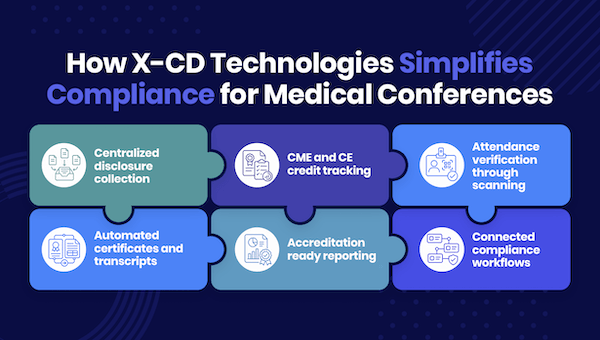
Managing compliance across CME documentation, conflict-of-interest disclosures, attendance verification, and credit reporting adds substantial administrative load to conference planning. X-CD’s CME conference software consolidates these workflows into one platform. It handles disclosure collection from speakers, co-authors, moderators, and session chairs. It tracks attendance through session scanning and monitors evaluation completion, and it automates certificate and transcript generation, along with clean compliance reports for accreditation bodies.
X-CD’s credit management module ties credits to specific accredited sessions and tracks each attendee’s participation against credit requirements. Speaker management automatically prompts all speakers, co-authors, and moderators to submit disclosures during the submission process, so admins can track completion status and export clean reports without manual follow-up.
To see how X-CD supports CME compliance for medical conferences, book a demo or request a free trial today.