
Medical conference management software typically costs between $900 and $50,000+ per year, depending on event size, feature requirements, and how the platform is priced. Some platforms publish fixed rate cards; others require a quote. This article breaks down the pricing models you’ll encounter, what drives cost differences across tiers, and how to evaluate options for cost-effectiveness.
What Is Medical Conference Management Software?
Medical conference management software is a platform that handles the operational workflows involved in planning, running, and reporting on medical and healthcare conferences. Core functions typically include attendee registration, abstract submission, peer review, session scheduling, speaker management, and post-event analytics. For CME-accredited events, the software also needs to track attendance and session participation, manage speaker disclosures, assign continuing education credits, generate certificates, and produce documentation for accreditation bodies such as ACCME.
Abstract management, specifically the process of collecting research submissions, coordinating peer review, and building a conference program from accepted content, is a defining requirement for medical conferences that generic event platforms often handle poorly. Platforms built specifically for this medical audience integrate abstract workflows with registration, scheduling, and CME reporting, ensuring data flows through a single system rather than across disconnected tools.
What Does Medical Conference Management Software Cost?
Medical conference management software ranges from approximately $900 to $50,000+ per year, with the spread largely driven by event complexity, attendee volume, and the modules included.
Entry-level platforms ($900–$2,000/year or per event): Purpose-built medical conference platforms with transparent pricing occupy this tier. Fourwaves, for example, offers an Essential Plan at $899 USD for up to 100 abstract submissions, an Advanced Plan at $1,799 USD for 200 abstracts with a full event website, and a Pro Plan at $5,000 USD for complex multi-track events with custom domains. All plans include abstract submission, unlimited registrations, peer review, basic program building, and attendee communication.
Mid-market platforms ($5,000–$15,000/year): Platforms serving associations running annual meetings with hybrid event support, CME tracking, and broader integration needs fall into this range. Some platforms in this tier, including InEvent, start at $9,000 per year on a flat annual model with a dedicated project manager included.
Association and enterprise platforms ($15,000–$50,000+/year): Large-scale platforms such as Cvent operate on custom-quote models. Based on buyer transaction data, Cvent contracts commonly range from $15,000 to $50,000+ per year, depending on modules and attendee volume, with multi-year commitments of two to three years often reducing annual costs.
These figures represent general base platform costs. Implementation fees, add-on modules, and support tiers can increase total annual spend considerably (see the cost factors section below). Some platforms also span more than one tier depending on how they’re configured. X-CD Technologies, for example, serves both mid-market associations running focused annual meetings and large medical societies managing complex multi-event programs, with modular pricing that scales to the organization’s actual scope rather than locking buyers into a fixed tier.
What Factors Affect the Cost of Medical Conference Management Software?
The primary cost drivers are event size, feature requirements, licensing model, and the level of support and integration included in the contract.
Attendee volume and event size: Many platforms price on a per-attendee or per-event basis. Whova, for example, charges approximately 3% plus $0.99 per ticket on a per-attendee model, which can add up quickly at high volumes. Flat-rate annual subscriptions, by contrast, will usually cover unlimited registrations regardless of headcount.
Feature requirements: Abstract submission management, CME credit tracking, accreditation reporting, speaker disclosure collection, and hybrid vs. virtual streaming each add cost, either as modules included in higher tiers or as add-ons priced separately. Abstract management is the feature most commonly associated with medical conferences and is often what distinguishes purpose-built medical platforms from general event tools.
Number of events per year: Organizations running a single annual conference often pay more per event than those on annual subscription plans covering multiple events. Per-event pricing is common for smaller or occasional organizers; flat annual licenses tend to deliver better value for associations running multiple programs.
Support and onboarding: Platforms positioned at the enterprise tier include dedicated account management, implementation support, and faster response SLAs as part of higher-cost contracts. Adding premium support to your chosen platform can increase annual contract value. Mid-market and specialty platforms often include responsive support as a standard feature rather than a paid tier.
What Is Included in Medical Conference Management Software at Different Price Points?
Entry-level ($900–$2,000/year or per event): Platforms at this tier generally cover the core workflow for smaller medical events: abstract submission for limited volume, unlimited registrations, email communication tools, a conference landing page, and a name badge generator. These platforms suit student symposia, single-track annual meetings, or events where administrative capacity is limited.
Mid-market ($5,000–$15,000/year): This tier often adds higher-volume abstract submission, multi-track session scheduling, peer review management, hybrid and virtual event support, basic CME credit tracking, and CRM or AMS integration. Pricing at this level may be published or quote-based depending on the platform.
Association and enterprise ($15,000–$50,000+/year or custom): Platforms at this level handle the full CME accreditation workflow: abstract collection and peer review, speaker and co-author disclosure management, attendance scanning, session evaluation, and self-assessment module (SAM) credit requirements, certificate generation, transcript access, and clean report exports for ACCME and specialty boards. X-CD Technologies, for example, integrates abstract submission, peer review, registration, speaker and exhibitor portals, badge printing, mobile apps, and CME credit tracking into one system, and supports multi-event management for associations running year-round programs.
Are There Cost-Effective Solutions for Medical Conference Management?
Yes, there are cost-effective solutions for medical conference management.
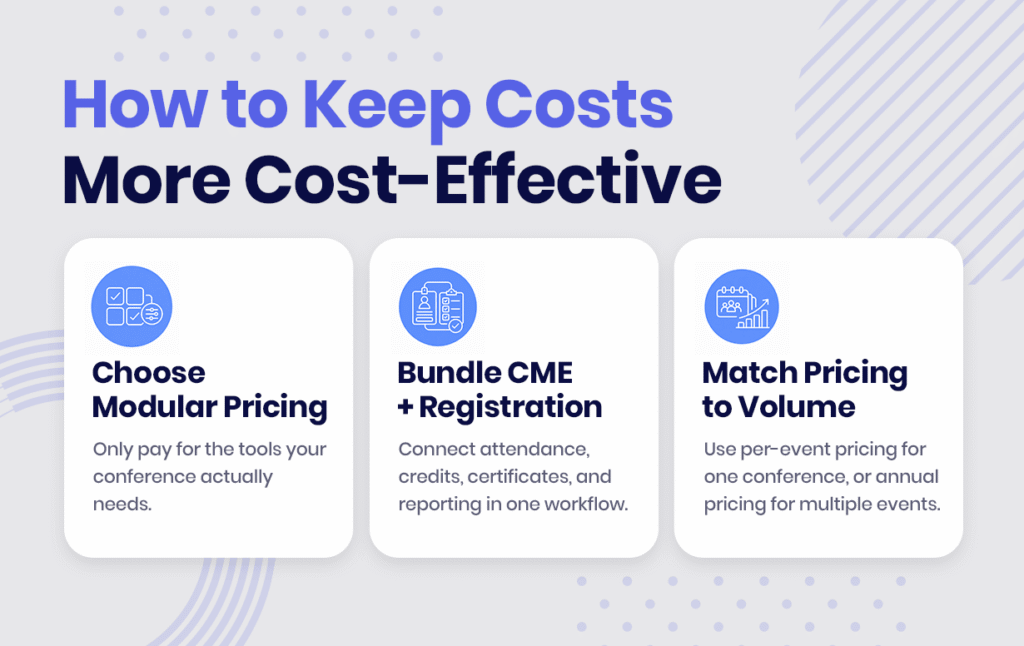
Modular platforms that charge only for what you use. X-CD Technologies, for example, operates on a fully modular basis, allowing associations to enable only the modules they need and scale as their requirements grow. This modular-design means you avoid paying for additional tools that your organization doesn’t need.
Match your pricing model to your event volume. Associations running multiple conferences, regional meetings, or workshops each year typically pay less on a flat annual subscription than on per-event fees that compound with each additional event. For organizations running a single conference annually, that math reverses: a per-event plan avoids paying for year-round platform access that sits unused between conference cycles.
Bundling CME tracking with registration. Using separate tools for registration and CME credit management creates duplicate data entry, reconciliation work, and additional licensing costs. Platforms that connect CME tracking directly to attendance scanning and session data, such as X-CD, reduce the staff time and error risk involved in manual reconciliation, which lowers the true cost of running a CME-accredited event.
How to Evaluate Medical Conference Management Software for Cost-Effectiveness
- Define your event volume before comparing pricing models. Determine whether you run one event per year or multiple. A per-event model costs less for single-conference organizers; an annual subscription typically delivers more value for associations running multiple programs.
- Request itemized quotes. Ask vendors to separate the base platform fee from module costs, implementation fees, and support tiers. Getting line-item pricing makes the total cost of ownership visible before you sign.
- Check whether CME tracking and accreditation reporting are included or add-ons. For CME-accredited events, the ability to collect disclosures, track attendance, assign credits, and export reports for ACCME is non-negotiable. Confirm whether these features sit in the base platform or require an additional module purchase.
- Calculate per-attendee cost at your expected volume. For platforms using attendee-based pricing, run the math at your actual headcount. A platform charging 3% plus $0.99 per registrant at 500 attendees costs meaningfully more than one charging a flat annual fee.
- Compare total annual cost against current staff hours spent on manual coordination. Organizations that have moved from spreadsheets to integrated platforms report significant reductions in administrative time. Fourwaves users report an average 50% reduction in administrative time after adopting the platform. Factor that labor saving into the cost comparison.
Medical Conference Management with X-CD
X-CD Technologies has supported medical associations for over 25 years with a platform built specifically for the workflows involved in CME-accredited conferences. The conference system covers abstract submission and peer review, speaker disclosure collection, registration, session scheduling, onsite badge printing, attendance scanning, CME credit tracking, certificate generation, and accreditation reporting, all in one connected platform.
For organizations managing both events and membership, X-CD’s AMS module connects conference data to member records, dues management, and CME history without requiring separate systems. X-CD operates on a modular pricing model, so organizations pay for what they need and scale from there. To discuss pricing for your event program, book a demo or start your free trial with X-CD.